
The Case for Operational Excellence from Seed to Sale
By Ken Feldman, Ph.D. | Lean Six Sigma Master Black Belt | Founder, CannabiSage LLC & Optec Consulting LLC
A $40 Billion Industry Running on Intuition
Search Amazon for a book on Lean Six Sigma in cannabis. You will find nothing. Search LinkedIn for a Master Black Belt working inside a cannabis company. The role does not exist. Search academic databases for a peer-reviewed article applying continuous improvement methodology to cannabis operations. The field is silent.
This is not a minor oversight. This is a $40 billion industry — one of the fastest-growing sectors in the American economy — operating almost entirely without the process discipline that every comparable industry adopted decades ago. Pharmaceutical manufacturers, food and beverage companies, consumer products giants, medical device makers: all of them were transformed by Lean Six Sigma. Cannabis has been left out of that conversation entirely.
“That’s either a problem or an opportunity, depending on who sees it first.”
The companies that recognize this gap now — and act on it — will have a structural advantage that is genuinely difficult for competitors to replicate. Operational excellence is not a technology purchase. It is a capability built over time, embedded in people, processes, and culture. First movers own it. Late movers buy it from consultants at a premium, after margin has already been lost.
Why This Matters Now: Three Converging Forces
1. Margin Compression Is Accelerating
The era of protected pricing in cannabis is over. As more states legalize, as competition intensifies, and as the illicit market continues to undercut legal operators on price, margin compression is no longer a threat on the horizon — it is the present reality. Companies that cannot drive cost out of their operations through process improvement will not survive the next five years. This is not projection; it is the pattern that played out in every other consumer goods industry that went through rapid commoditization.
2. Federal Rescheduling Is Changing the Compliance Landscape
The DEA’s movement toward Schedule III rescheduling is pulling medical cannabis operators toward pharmaceutical-grade compliance obligations. Good Manufacturing Practice (GMP) requirements, documentation standards, process validation, and quality systems that were once optional best practices are becoming baseline expectations. Pharmaceutical companies have used Lean Six Sigma as the operational backbone of GMP compliance for thirty years. Cannabis operators are about to need the same infrastructure — most have not started building it.
3. Multistate Expansion Requires Operational Standardization
Growth across state lines demands something that most cannabis organizations have never built: a repeatable, transferable operating model. Expanding into a new state is not just a licensing event. It is the exportation of your processes, your quality standards, your workforce training, and your supply chain controls. Without a documented, disciplined operating system, every new facility becomes a new experiment — with all the waste, variation, and risk that implies.
What Is Lean Six Sigma? The One-Paragraph Version
Lean Six Sigma is a management methodology that combines two complementary disciplines. Lean eliminates waste — the activities that consume time, labor, and capital without creating value. Six Sigma eliminates variation — the inconsistency that produces failed batches, compliance findings, rework, and customer complaints. Together, applied through a structured framework called DMAIC (Define, Measure, Analyze, Improve, Control), they convert operational chaos into predictable, auditable, improvable processes. For an executive, the essential point is this: Lean Six Sigma is not a factory-floor technique. It is a system for running a better business.
Where It Applies: The Full Value Chain
The most common misconception about Lean Six Sigma in cannabis is that it only applies to cultivation or manufacturing. In practice, every stage of the cannabis value chain contains waste to eliminate and variation to control. The graphic below presents the Lean Principles and Six Sigma Benefits and maps the specific applications from genetics through consumer delivery.
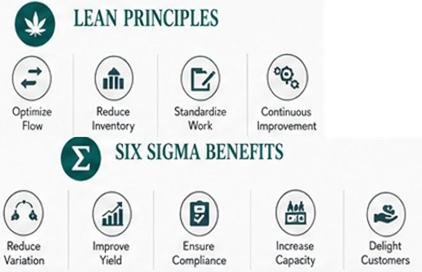
Figure 1: Seed-to-Sale Six Sigma Value Chain — Lean eliminates waste across every stage; Six Sigma controls the variation that drives quality and compliance failures.
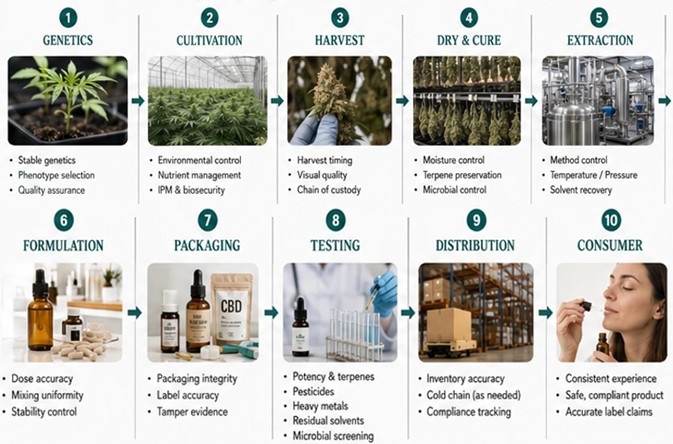
Figure 2: Seed-to-Sale Six Sigma Value Chain — How Lean Six Sigma applies
A few specific examples worth highlighting for executive consideration:
- Yield variability: In cultivation, environmental parameter variation — temperature, humidity, CO₂, light intensity — is the primary driver of yield inconsistency. Statistical process control charts applied to these inputs can reduce yield variability by 70% or more, based on comparable applications in controlled-environment agriculture and pharmaceutical biologics.
- Batch failures: In extraction and manufacturing, batch right-first-time rates below 90% are common in early-stage cannabis operations. A structured Six Sigma improvement project targeting formulation consistency typically achieves 95%+ right-first-time within two to three cycles — eliminating rework costs and the compliance exposure that comes with repeated
- Audit readiness: In compliance and quality, most cannabis operators treat audit preparation as a periodic fire drill. Organizations running structured process control systems — where documentation, traceability, and deviation management are continuous rather than episodic — experience audits as confirmations of existing practice, not crises.
- Inventory performance: In retail and distribution, inventory shrink and demand forecasting errors are the silent margin killers. Lean inventory management and data-driven procurement can reduce capital tied up in unsold product by 20–35% while simultaneously improving in- stock rates on high-velocity SKUs.
One important note for cannabis operators: the word “waste” carries a specific regulatory meaning in METRC-tracked operations. In Lean methodology, waste refers to the eight categories of non-value- adding activity — overproduction, waiting, unnecessary transport, over-processing, excess inventory,
unnecessary motion, defects, and underutilized talent. These are distinct from regulatory waste designations. The translation between frameworks matters and should be managed explicitly.
What Good Looks Like: The Cannabis Excellence Pyramid
Most cannabis organizations, if assessed honestly, are operating at the base of the pyramid below — focused on compliance as a license-to-operate requirement, with operational performance left largely to tribal knowledge and individual expertise. The companies that will define the next decade of cannabis are building upward: from compliance foundation through operational excellence and process capability to the business results and customer trust that create durable competitive advantage.
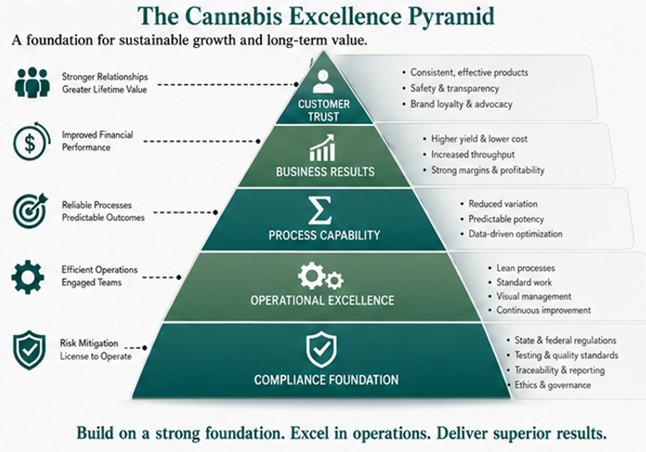
Figure 3: The Cannabis Excellence Pyramid — sustainable growth requires building from compliance upward through operational discipline to business results and customer loyalty.
The pyramid is not aspirational decoration. Each level has specific, measurable characteristics:
- Level 1 — Compliance Foundation: State and federal requirements met consistently, not episodically. METRC accuracy above 5%. Testing and quality standards met as a byproduct of process control, not last-minute correction.
- Level 2 — Operational Excellence: Lean processes eliminating the eight Standard work documented and practiced. Visual management systems making problems visible before they become failures. Continuous improvement as a management habit, not an annual initiative.
- Level 3 — Process Capability: Reduced cannabinoid potency Predictable, data-driven production. Measurement systems validated. Decisions driven by process data rather than experience alone.
- Level 4 — Business Results: Higher yield at lower Increased throughput. Strong and improving margins. A financial profile that supports reinvestment and expansion.
- Level 5 — Customer Trust: Consistent, effective products that deliver on label Safety and transparency that withstand regulatory scrutiny. Brand loyalty and advocacy that survive competitive pressure.
Proof of Concept: Adjacent Industries That Made This Transition
Cannabis operators do not have to prove that Lean Six Sigma works. That proof exists in every comparable industry that faced a similar inflection point.
Pharmaceutical manufacturing faced the same moment when FDA’s cGMP enforcement intensified in the 1990s and 2000s. The companies that embedded Lean Six Sigma as their operating backbone — Merck, Eli Lilly, Genentech, Roche — built quality systems that turned regulatory pressure into competitive advantage. The companies that treated GMP as a compliance checkbox continued to struggle with recalls, warning letters, and import alerts.
Food and beverage went through an equivalent transformation under FSMA (Food Safety Modernization Act). Craft breweries, which share cannabis’s combination of biological variability, small-batch complexity, and quality-sensitive consumers, have adopted Lean manufacturing principles widely — with measurable results in consistency, waste reduction, and scalability.
The pattern is consistent: industries facing a regulatory inflection point, combined with margin compression and growth complexity, adopt operational excellence methodology. The leaders do it proactively. The followers do it reactively, at higher cost, after competitors have already captured the advantage.
“Cannabis is at the beginning of that inflection point. The window for first-mover advantage in operational excellence is open. It will not stay open indefinitely.”
The Conversation Worth Having
This article is not a methodology overview. It is an invitation to a different kind of strategic conversation
- one that most cannabis leadership teams have not yet had The questions worth asking in that conversation:
- What is our current first-pass yield at each production stage, and do we know specifically what is driving the failures?
- If we doubled production volume tomorrow, would our processes produce consistent results —
or would our problems simply double in scale?
- Are our compliance activities building a quality system, or are they consuming resources that could be driving operational improvement?
- If a major multistate operator entered our market with mature operational infrastructure, how long would our current cost structure remain competitive?
These are not rhetorical questions. They are diagnostic. The answers determine whether operational excellence is a priority for your organization today, or a crisis you will manage later at greater cost.
The methodology exists. The proof of concept exists. The regulatory momentum exists. What the cannabis industry does not yet have is the credentialed operational expertise to translate all of that into execution. That gap is the opportunity — for operators willing to move first, and for the industry organizations positioned to build the infrastructure that helps them do it.
Ken Feldman, PhD is a Lean Six Sigma Master Black Belt with over four decades of deployment experience including FDA-regulated pharmaceutical manufacturers including Merck, Eli Lilly, Roche, Genentech, Lannett Company Inc., and Fresenius Kabi. He holds credentials from GE Capital and Accenture Consulting and is a Medical Cannabis Specialist certified through Green Flower. He is the founder of CannabiSage LLC, a therapeutic cannabis education platform, and owner of Optec Consulting, LLC. He can be reached at DocKen@optecconsulting.com